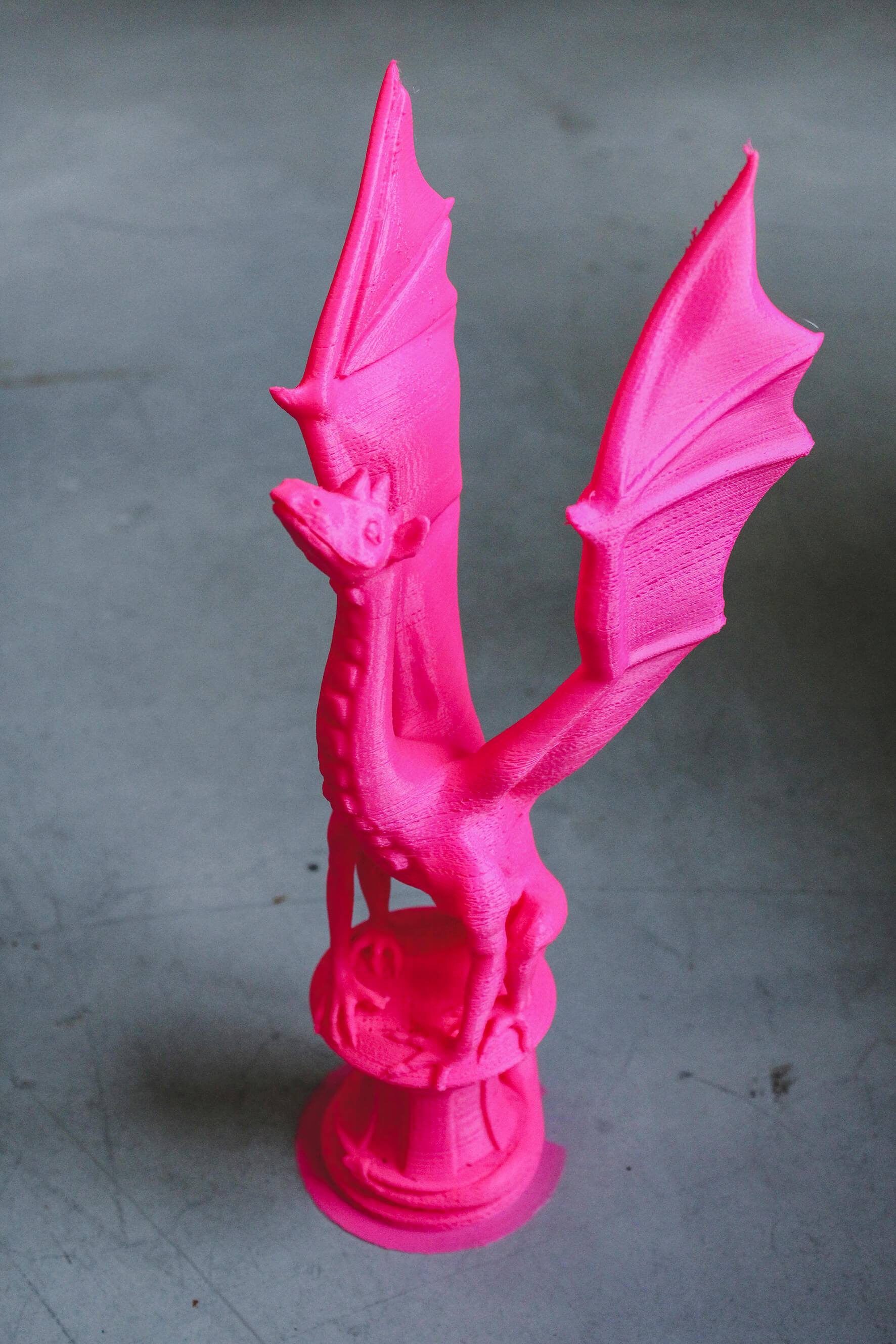
Taking place as part of Plymouth Art Weekender, the UK's biggest art weekender, Fab Lab Plymouth will be running a Dragon Making Workshop. Come along and join the Fab Lab Plymouth team, and learn how to use the latest digital technology to make your ideas come to life.
Open to all ages and abilities, a range of activities on will be on offer, including 3D printing bespoke dragons and designing and making personalised shields.
So, if you have been inspired by the work of George R R Martin or you just want to find out more about the creative possibilities afforded by Fab Lab Plymouth, come along and see us.
What: Dragon Making Workshop
Where: Fab Lab Plymouth, Plymouth College of Art, Tavistock Place, PL4 8AT
When: Saturday 23 September, 10:00am - 4:00pm
Enquiries: fablab@pca.ac.uk
Devon Guild of Craftsmen members have taken advantage of the machines and technical expertise available at Fab Lab Plymouth with a glassmaker, jeweller, sculptor, contemporary furniture maker, textile designer and two printmakers all progressing from their initial introductory day to further, more specialised sessions.
Guild Member Roberta Ayles, a glass artist who has been experimenting with glass and ceramic processes for 40 years, describes how her intial sessions in the Fab Lab have informed her stained glass practice.
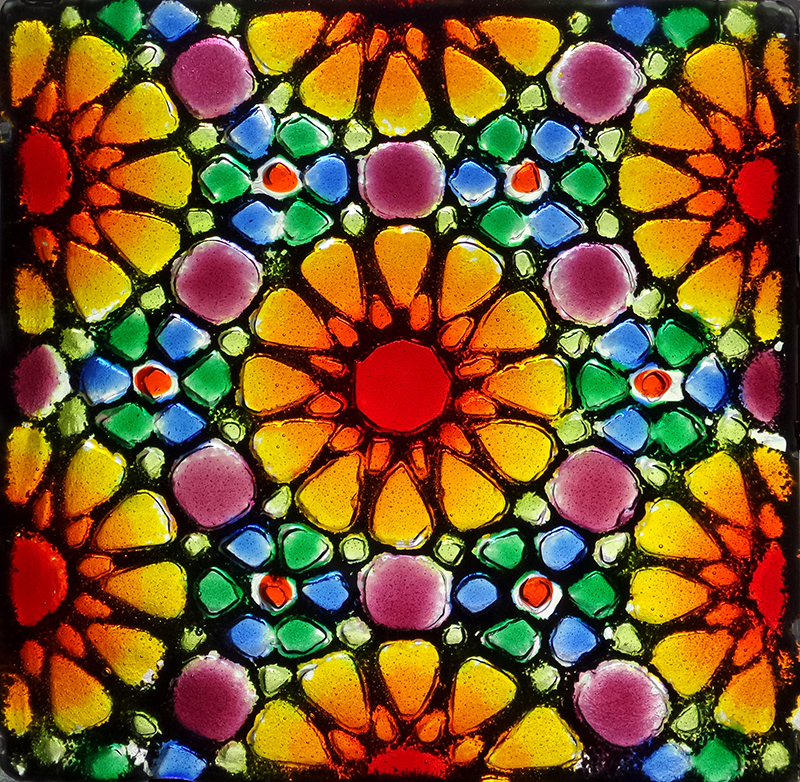
"My design was borrowed from an Islamic mosaic, and then cut in 3mm Perspex on the laser cutter. From this, I took an impression in clay, and from the clay I cast a plaster and a Gelflex version. From the Gelflex I took another plaster cast, so I had a positive and negative of the same design."
"I was particularly interested in geometric or intricate patterns which would have been very time-consuming to cut by hand, and I look forward to trying different colourways from these moulds."
Roberta has gone on to produce a piece for her summer exhibition using a mould made with the Fab Lab Plymouth laser cutter.


"The initial session was fascinating and sparked off several ideas. I would be really interested in investigating how I could use CAD and CAM to speed up the initial stages of manufacture."
— Jeweller Ann Bruford was similarly inspired by her Fab Lab experience.
Devon Guild Exhibitions Officer Flora Pearson has also been exploring the facilities at Fab Lab Plymouth and has looked at the potential of the laser cutter in relation to print making.
"I have been attending the FabLab course for four weeks and have found it enthralling, exhausting, inspiring and exciting in equal measures – it’s a journey beyond my comfort zone. I have been working on ways to produce a block for hand-printing wallpaper as the technology would provide a precision which would be really useful for matching up or tiling a wallpaper design."


"My experience of working alongside other craftspeople in the FabLab has shown me that the end product of the machines is very much the tip of the iceberg. Everyone has a lot of knowledge, experience and understanding, and is looking for ways to push the boundaries of what can be produced; to perhaps create something which would have taken hundreds of hours, or reproduce something more than once for example."
— Flora Pearson, Devon Guild of Craftsmen Exhibitions Officer


The Made@EU project aims to bridge the “digital divide” that currently hinders the widespread use of digital fabrication knowledge and technologies in the European cultural and creative sectors, especially in the field of design, arts and crafts. Fab Lab Plymouth is uniquely positioned next to Plymouth College of Art’s craft and design workshop complex, creating the perfect setting to fuse traditional crafts with new technologies.
The project brought together five institutional partners from France, Spain, UK, Netherlands and Hungary and began with a series of intensive workshops, introducing digital 3D systems to artists, craftspeople and designer-makers from across Europe.
“The facilities at Plymouth College of Art are incredible, and the Fab Lab staff were incredibly patient, helpful and supportive.”
— Phil Cuttance, a designer/maker from New Zealand
Working in partnership with École Nationale Supérieure de Création Industrielle (ENSCI) Paris, Institut d’Architectura Avancada de Catalunya (IAAC) Barcelona, WAAG Society: Institute for Art Science & Technology in Amsterdam and FabLab in Budapest, we invited emerging designers and creative talent to put forward proposals for enhancing their practice utilising FabLab facilities, offering a number of subsidised residencies to give access to both Fab Lab Plymouth and Plymouth College of Art’s specialist traditional workshops.
Artists were enabled to develop projects that creatively investigated the merging of traditional crafts with 3D digital ‘maker’ technologies. Participants included Adriana Ionascu, Alfie Smith, Jack West, Laura Martinez, Mark von Rosenstiel, Matthew Bush and Phil Cuttance, Ludovic Mallegol and Annemie Maes.
The resulting work was showcased in an exhibition at The Gallery at Plymouth College of Art, which featured sculpture, animated film, furniture and architectural models.


Phil Cuttance, a designer/maker from New Zealand who is based in London and participated in a residency at Plymouth College of Art as part of Made@EU, said, “The facilities at Plymouth College of Art are incredible, and the Fab Lab staff were incredibly patient, helpful and supportive.”
Hannah Harris, Director of Development at Plymouth College of Art, said, “The project is as much an exercise in exploring new technologies, materials and processes, as it is in making art works.
“Made@EU offered a unique opportunity to the resident artists to undertake an experiment with unknown outcomes in the reassuring setting of the Fab Lab, with full access to high end digital skills and equipment.
“This collaborative project has been beneficial for all parties, for the artists to develop new skills and to push the boundaries of the Fab Lab itself.
“The European dimension is incredibly important and exposes staff, students and artists to opportunities that would not otherwise be possible.”
Photos by Dom Moore.